

The Surprisingly Complicated History of the Wooden Pencil
You probably have a pencil within arm’s reach right now.
It’s one of the most boring objects we own.
Except… it has been involved in war, secretive mining, international trade, Henry David Thoreau, and some very aggressive branding.
Here’s how a chunk of graphite became the pencil.
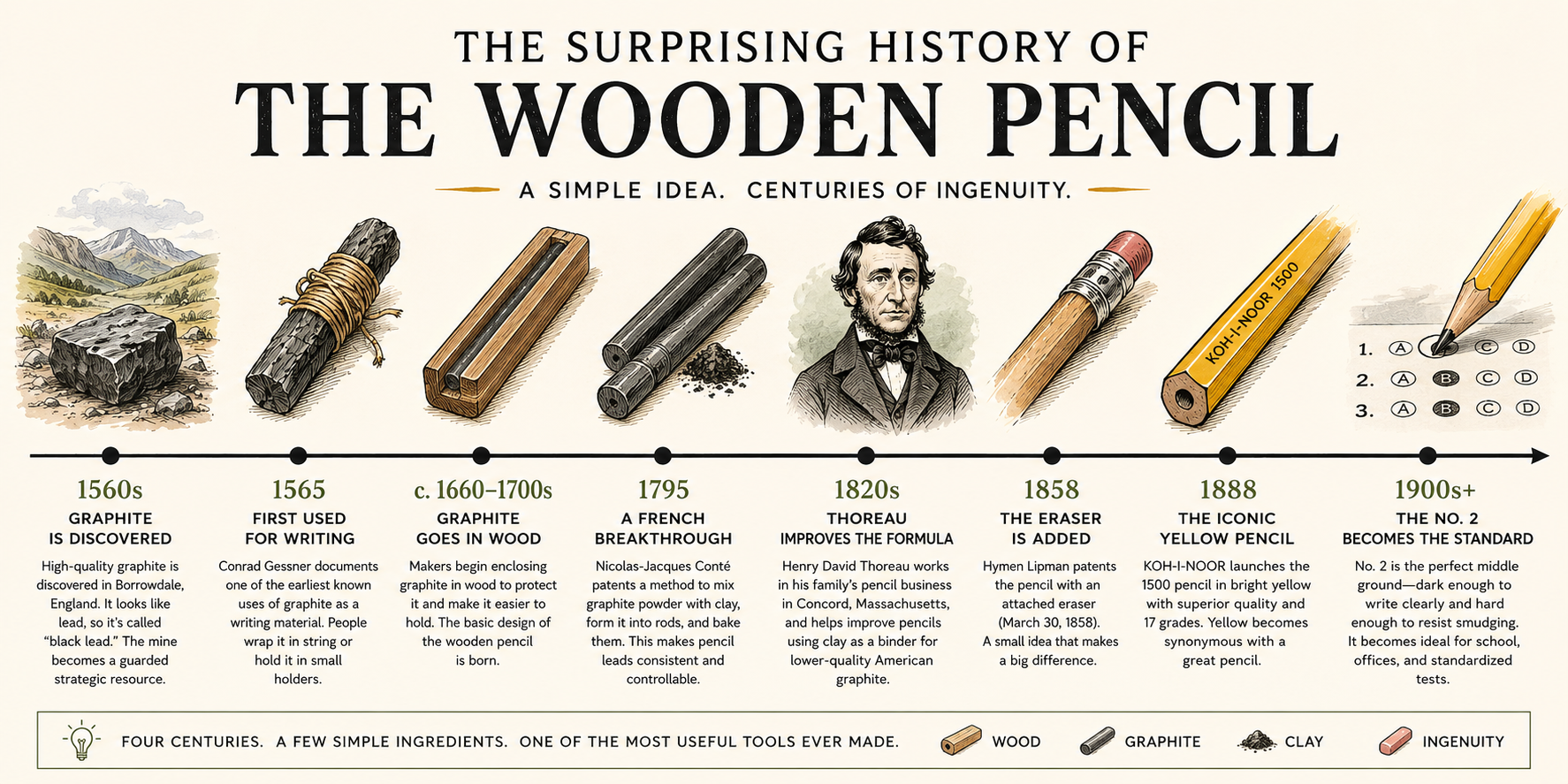
The 1500s: Someone finds a very strange rock
In the 16th century, people in Borrowdale, England, discovered an unusually pure deposit of graphite.
It was soft. It was dark. And it made a fantastic mark.
People didn't yet understand what it was, so they called it “black lead.”
And graphite wasn't just useful for writing.
It could also be used in making molds for cannonballs.
Suddenly, this weird black mineral was valuable enough to control and protect.
1565: Put it in a holder
By 1565, Swiss naturalist Conrad Gessner had documented graphite being used as a writing instrument.
Early users wrapped graphite in string or put pieces into holders so they could actually hold onto the stuff without covering their hands in black dust.
The basic idea of the pencil was taking shape.
But there was still a problem:
Good graphite was hard to get.
1795: The French find a workaround
During the French Revolutionary period, English graphite wasn't exactly easy for France to obtain.
So French engineer Nicolas-Jacques Conté came up with a solution.
In 1795, he patented a method of grinding graphite into powder, mixing it with clay, forming it into sticks and firing them.
Brilliant.
Now pencil makers didn't need huge chunks of perfect natural graphite.
They could make the graphite core themselves.
And by changing the amount of clay, they could make pencils harder or softer.
That basic principle is still used today.
1802: The idea catches on
The graphite-and-clay method continued spreading.
In 1802, Joseph Hardtmuth's company patented its own method for producing graphite-and-clay pencil leads.
The pencil was officially becoming an industrial product rather than a clever little piece of graphite in wood.
The 1820s: Enter Henry David Thoreau
Yes.
That Henry David Thoreau.
Thoreau's father, John, was making pencils in Concord, Massachusetts by the 1820s.
Henry David Thoreau later became a proprietor in the family business and helped improve the company's pencils by using clay as a binder for lower-quality New England graphite.
The man who would eventually write Walden was, for a while, helping make better pencils.
Honestly, that's pretty perfect.
1858: Somebody finally puts an eraser on it
On March 30, 1858, Philadelphia inventor Hymen Lipman received a U.S. patent for combining a pencil and an eraser.
It wasn't the beginning of erasers, and Lipman's patent was later invalidated, but the idea was brilliant:
Make the mistake-remover part of the pencil.
No separate eraser required.
1888: The pencil goes yellow
Now for one of the strangest parts.
In 1888, Austrian manufacturer KOH-I-NOOR HARDTMUTH launched the KOH-I-NOOR 1500, a bright yellow pencil made in 17 grades.
Yellow wasn't just a random fashion choice. The pencil was deliberately positioned as a premium product and was named after the famous Koh-I-Noor diamond.
It worked.
The yellow pencil became iconic.
And eventually, yellow stopped meaning luxury pencil and started meaning simply:
pencil.
So what about the No. 2?
The numbers on pencils tell you about the hardness of the core.
More graphite generally means a softer, darker mark. More clay means a harder, lighter one.
In the American 1-to-4 system, No. 2 became the useful middle ground: dark enough to write clearly without being excessively soft.
Eventually, that made it especially useful for machine-scored tests.
Which is how a material discovered in an English valley in the 1500s ended up inspiring the sentence every American student knows:
“Bring two sharpened No. 2 pencils.”
And that's the weird part.
The pencil looks simple because hundreds of years of people worked very hard to make it simple.
Graphite.
Clay.
Wood.
A little yellow paint.
That's it.
But behind that little wooden stick is a history of mining, manufacturing, invention, marketing and craftsmanship stretching back more than four centuries.
Not bad for something you lose under the couch.